Who are the Freemasons?
‘You’re never a Freemason?’
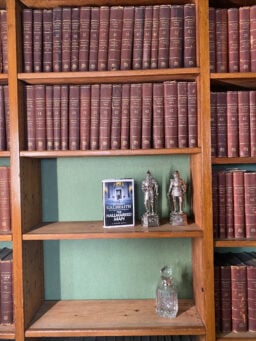
The Hallmarked Man, Robert Galbraith
‘Course I’m bloody not,’ said Strike, with a snort.
‘Well, I might not know! It’s a secret society, isn’t it?’
‘“A society with secrets”, that’s the line.
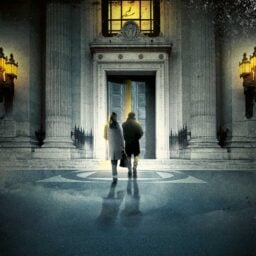
When a mutilated body is discovered in the vault of Ramsay Silver, the press focus on the connections between the crime and Freemasonry. The murder, and theft of a valuable collection of silver from the shop which happened on the same night, is a gift for conspiracy theorists, particularly those who have long suspected the Freemasons of wielding undue influence in society. Ramsay Silver specialises in masonic regalia and is situated within yards of Freemasons Hall, the dramatic Art Deco building in central London which is the hub for Freemasonry in the UK. In addition, the mutilated body was discovered wearing a masonic sash.
Before Robin Ellacott and Cormoran Strike are hired to investigate however, the police dismiss any masonic connection and provisionally identify the body as that of a known armed robber. When that identification begins to look shaky, Decima Mullins hires Strike and Robin to prove the body is in fact that of her missing boyfriend. Pursuing possible identities for the murdered man and trying to pick apart the motives behind the bizarre case, the detectives find themselves constantly brushing up against the symbolism of Freemasonry, and the strange theories and obsessions which circulate around it. You can hear Robert Galbraith talking about the research for this part of the story here.
‘I had a look through all the news coverage of the murder, while I was off,’ said Robin. ‘People talking about the masonic legend of Hiram Abiff. Had you ever heard of him?’
The Hallmarked Man, Robert Galbraith
The freemasons are a fraternal society organised in lodges around the world. Over eight thousand lodges operate in the UK today, and wandering round any town, large or small, you may well come across a lodge marked with the signs of freemasonry, the compass and set square. The designs often include the letter ‘G’ too, standing for geometry or God. The letter ‘G’ is used to intimidate the detectives during the investigation; Strike finds it painted on the door to the office in Denmark Street, though the letter has a particular, non-masonic significance for Robin too.
The origins of Freemasonry are mysterious and obscured by generations of myth-making. What’s certain is that medieval masons – experts in building in stone – formed trade associations to protect the secrets of their craft and ensure best practices. The workshops they used – sometimes temporary huts where they could work out of the weather – were called lodges. By the sixteenth century the word ‘lodge’ meant the association of craftsmen as much as a particular building. In 1598, the Master of Works for James VI of Scotland (later also James I of England) issued a sort of governing document for the masons. It was designed to make sure the men hired to build or repair the palaces of the realm were qualified and also called on the masons to live charitably together as becomes sworn brothers and companions in the craft.
From around this time men began to join the lodges who weren’t stone masons. It seems they were attracted by scientific curiosity, and the fact that the lodges were safe spaces where, during a century of religious and civil turmoil, politics was left at the door, and a bond of silence meant members could speak freely.
Early in the eighteenth century four lodges of London joined together to form the first ‘Grand Lodge’, a central lodge which had authority over other individual ones. The current Freemasons Hall was built in the aftermath of World War I on a site which they had used to meet since 1775.
So much for the facts available in the historical record. Freemasonry though has long claimed a heritage that reaches back to biblical times, including the story of Hiram Abide the legendary original Grand Master Mason and builder of Solomon’s Temple. Though he doesn’t appear in the bible, as Strike tells Robin, Hiram was supposedly the most skilful artificer of Solomon’s temple, murdered for refusing to divulge the Master Mason’s secrets. The masons do make a promise of secrecy as Strike explains, intoning ‘I will keep a worthy brother Master Mason’s secrets inviolable, when communicated to and received by me as such, murder and treason excepted.’
‘And what’s all this?’ said Strike, turning to point at the strange assemblage of objects in the middle of the chequerboard floor.
The Hallmarked Man, Robert Galbraith
‘Now, there, I’d have to kill you if I told you,’ said Hardacre.
Strike knows something about Freemasonry because his old colleague, Graham Hardacre, is a mason. As the investigation continues, he gives Strike a private tour of Freemasons Hall. Though different branches of Freemasonry developed different rituals of initiation and progression within the society, Graham explains there are many beliefs held in common, particularly belief in a single higher power, the Great Architect of the Universe. How members interpret what that power is, is up to them.
Many details of the rituals are private, as Graham Hardacre notes, though some elements, like rolling up a trouser leg to show you are unshackled which Strike mentions, are more widely known.
Despite the private nature of the rituals, Freemasons Hall is open to the public and Robin is surprised to see, has a museum, café and a gift shop. As Robert Galbraith notes, you’ll see some very impressive architecture if you visit. Not everyone gets a private visit as Strike does, but Robert Galbraith was spotted taking notes in the café and was invited on one too.
Murdoch amassed the biggest, most important collection of masonic artefacts in the world, some commissioned from silver from his own mine, others collected over many years. These included the ceremonial dagger of John Skene, the first Freemason ever to emigrate to America.
The Hallmarked Man, Robert Galbraith
Freemasonry is international – there are lodges all over the world – and has a strong and established presence in America. The silver stolen on the night of the gruesome murder was collected and commissioned by a Scottish freemason, A. H. Murdoch, who made his fortune in Peru in the nineteenth century and was Inspector General of the Louisiana jurisdiction. As well as the ceremonial dagger of John Skene, a Quaker, and the first Freemason to emigrate to America, his collection includes a Nef modelled on Carolina Merchant, the ship which, according to silver shop owner Kenneth Ramsay, took Skene across the Atlantic Ocean.
Murdoch and the collection of silver he owned exist only in the world of Robin and Strike, but John Skene was a real historical figure often credited with bringing freemasonry to America.
‘“Audi, vide, tace,”’ said Strike, reading an inscription high above them. ‘“See, hear, be silent.”’
The Hallmarked Man, Robert Galbraith
The motto that Strike reads on the front of Freemasons Hall in London – See, hear, be silent – is a reminder of the origins of the Freemasons as a place members could speak freely, knowing their words wouldn’t be used against them outside the lodge. It also recalls the principles of self-improvement important to the society. Members should pay attention to the world but be careful to speak only when they have something of worth to say. Of course, Freemasons are only human, so as Strike and Robin discover members aren’t always silent, and sometimes efforts to protect the privacy of the lodge can have unfortunate consequences. Still, the motto is not a bad code of conduct for detectives as well as Freemasons. There are times though, as the investigation reaches its devastating conclusion, that Strike and Robin are too silent for their own good and Strike finds he can keep his own secrets no longer.